Geometric Flowers Embroidery Patterns: Elevating Textile Art with Modern Precision
The intersection of traditional craftsmanship and modern digital design has given rise to a fascinating niche in the creative world: Geometric Flowers Embroidery Patterns. This style merges the organic, flowing nature of floral motifs with the rigid, mathematical precision of geometric shapes. The result is a visual language that feels both timeless and contemporary, appealing to a wide spectrum of creators ranging from professional textile designers to hobbyist crafters. As the demand for unique, high-quality digital assets grows, understanding the nuances of these patterns becomes essential for anyone looking to produce standout work in apparel, stationery, or home decor.
Unlike traditional botanical illustrations that rely on soft curves and naturalistic shading, geometric embroidery designs utilize sharp lines, repeating polygons, and symmetrical arrangements to depict flora. This approach not only offers a fresh aesthetic but also presents distinct advantages in terms of production efficiency and scalability. Whether you are looking to create custom tumbler wraps, design intricate scrapbook pages, or develop a new line of fabric prints, mastering the application of these patterns can significantly enhance the value and appeal of your projects.
The Aesthetic Appeal of Structured Florals
To understand why Geometric Flowers Embroidery Patterns have gained such traction, one must first appreciate their visual impact. The human eye is naturally drawn to symmetry and order. By deconstructing a flower into its constituent geometric parts—such as hexagonal centers, triangular petals, or circular stamens—designers create an image that is instantly recognizable yet intellectually stimulating. This style bridges the gap between abstract art and representational imagery, making it versatile enough for minimalist interiors and bold fashion statements alike.
The use of color plays a pivotal role in this aesthetic. When paired with vibrant palettes, geometric florals pop with energy, while monochromatic schemes offer sophistication and elegance. This flexibility allows creators to adapt the same underlying pattern structure to vastly different moods and markets. For instance, a pastel-colored geometric rose might be perfect for a baby shower invitation, whereas a high-contrast black-and-white version could serve as a striking background for a corporate brochure.
Technical Specifications and Quality Standards
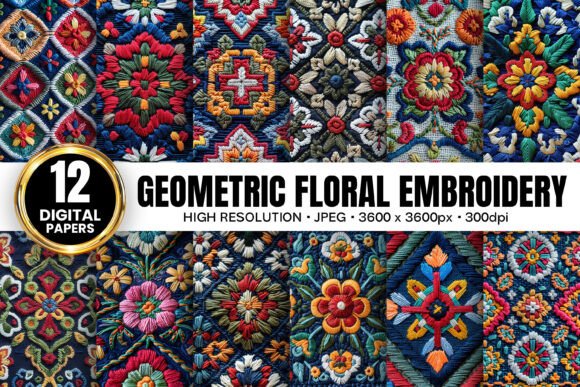
In the realm of digital design, quality is paramount. Low-resolution images often result in pixelation when scaled up, ruining the crisp lines that define geometric art. Therefore, professionals prioritize high-fidelity assets. A standard offering in this category typically includes 12 High-Resolution Digital Papers contained within a single, easily accessible ZIP file. This bundling ensures that users receive a cohesive collection, maintaining visual consistency across various project components.
The technical specifications of these files are designed to meet the rigorous demands of both screen and print media. Each file is provided at 300 DPI (Dots Per Inch), which is the industry gold standard for high-quality printing. At this resolution, fine details remain sharp, and edges stay clean, preventing the blurriness that often plagues lower-quality downloads. Furthermore, the dimensions of 3600 x 3600 pixels (equivalent to 12″ x 12″ at 300 DPI) provide ample space for cropping and resizing without compromising integrity. This square format is particularly advantageous for social media graphics, gift tags, and standard paper crafts.
Files are delivered in JPG format, ensuring broad compatibility with almost all design software, from Adobe Photoshop and Illustrator to Canva and Microsoft Word. While PNG formats preserve transparency, JPGs are universally supported and offer efficient file sizes for quick loading and sharing. Understanding these technical details helps creators avoid common pitfalls, such as printing blurry images or encountering compatibility issues with their preferred editing tools.
Diverse Applications Across Industries
The versatility of Geometric Flowers Embroidery Patterns extends far beyond simple decoration. These patterns serve as foundational elements in numerous industries, each leveraging the unique properties of the design for specific outcomes.
- Gift Wrapping and Stationery: In the gifting sector, presentation is everything. Using these seamless patterns for wrapping paper adds a layer of exclusivity and thoughtfulness. They are equally effective in designing greeting cards, where the structured lines complement heartfelt messages without overwhelming the text.
- DIY Crafts and Scrapbooking: Hobbyists frequently incorporate these digital papers into physical crafts. They can be printed and cut out for scrapbook layouts, used as backgrounds for journal pages, or laminated for durable placemats. The durability of the geometric design means it holds up well under repeated handling and cutting.
- Textile and Apparel Design: Fashion designers utilize these patterns for fabric prints, scarves, and accessories. The seamless nature of the patterns allows for endless tiling, creating continuous designs that flow seamlessly across garments. This is particularly popular in summer collections where light, airy floral motifs are favored.
- Digital Backgrounds and Wallpapers: For content creators and gamers, these patterns make excellent desktop or mobile wallpapers. Their balanced composition ensures that icons and widgets remain visible against the busy yet orderly background.
- Custom Merchandise: The rise of print-on-demand services has made it easier than ever to apply these designs to physical products. From tumbler wraps that keep drinks cold to book covers that protect literature, the high resolution ensures that the final product looks professional and polished.
Benefits for Professional and Amateur Creators
For professionals, time is money. Sourcing pre-made, high-quality Geometric Flowers Embroidery Patterns eliminates the need to draw complex vectors from scratch. This acceleration in workflow allows designers to focus on layout, typography, and client communication rather than reinventing the wheel. Moreover, owning a diverse library of patterns provides a safety net for last-minute projects or brainstorming sessions.
Amateur enthusiasts benefit similarly by gaining access to professional-grade assets. Many beginners struggle with perspective and proportion when trying to draw flowers. Geometric patterns simplify this process by providing a structured guide. Users can trace, overlay, or simply print and use these patterns as bases for their own artistic interventions, such as hand-lettering or adding watercolor washes.
Another significant advantage is the cost-effectiveness. Purchasing a bundle of 12 high-resolution digital papers is often more economical than commissioning custom illustrations or buying multiple individual stock images. Additionally, because these are DIGITAL products, there are no shipping costs or wait times. Instant download capabilities mean that inspiration can be turned into reality immediately.
Considerations for Implementation
While the benefits are clear, there are practical considerations to keep in mind when working with digital patterns. First and foremost is color accuracy. Since these files are intended for both digital display and physical printing, users should be aware that colors may vary slightly depending on monitor settings and printer calibration. RGB values on screens often appear brighter than their CMYK counterparts in print. To mitigate this, designers should always proof-print a small section before committing to a large batch of materials.
Another consideration is the intended scale of the design. Although the files are high-resolution, extremely large-scale applications, such as mural wall art, may require vectorization. Converting the raster JPG files into vector formats (like SVG or EPS) using tracing software can ensure infinite scalability without loss of quality. However, for most standard uses like crafting planners, invitations, and custom apparel prints, the 300 DPI JPGs are more than sufficient.
Educators and researchers may find these patterns useful in teaching principles of symmetry, tessellation, and color theory. The repetitive nature of Colorful Geometric Flowers Embroidery Seamless Patterns offers a tangible example of how mathematical concepts manifest in art. Students can analyze how changing the angle of a polygon alters the perceived movement of the flower, fostering a deeper understanding of visual dynamics.
Maximizing Creativity with Seamless Tiling
A key feature of many of these digital papers is their seamless capability. This means that when the pattern is tiled horizontally and vertically, the edges align perfectly, creating an uninterrupted surface. This is crucial for applications like textile design and wallpaper creation, where visible seams would ruin the illusion of a continuous design.
Creatives can experiment with scaling and rotation to transform the look of the pattern. Doubling the size of the pattern in design software can create a bolder, more impactful statement, while reducing the size can yield a subtle, textured background. Mixing different geometric floral patterns from the same collection can also add depth and complexity to a project, provided the color palettes remain harmonious.
Conclusion
The integration of Geometric Flowers Embroidery Patterns into creative workflows represents a smart fusion of aesthetic beauty and functional utility. With high-resolution outputs, versatile applications, and professional-grade specifications, these digital assets empower a broad audience to produce exceptional work. Whether you are designing a wedding invitation suite, updating your wardrobe with custom prints, or exploring new avenues in textile art, these patterns provide a reliable and inspiring foundation. By understanding the technical requirements and creative possibilities, users can fully leverage these resources to bring their visions to life with clarity and precision.