Evaluating Dotted Circles Digital Paper Patterns for Creative Projects
In the evolving landscape of digital design and print-on-demand services, the quality and versatility of background assets play a critical role in the final output. Among the various resources available to designers, crafters, and small business owners, Dotted Circles Digital Paper Patterns have emerged as a specific category of high-resolution assets that offer distinct advantages for both physical production and digital layout work. This analysis explores the technical specifications, practical applications, and comparative benefits of these downloadable JPG patterns, helping users determine if they align with their specific creative workflows.
Technical Specifications and Resolution Standards
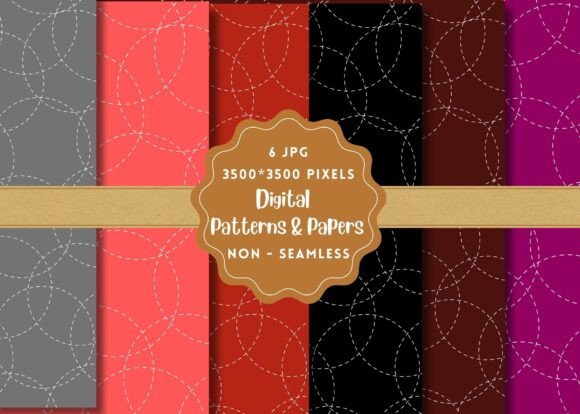
The foundation of any reliable digital paper pattern lies in its resolution and file integrity. The Dotted Circles Digital Paper Patterns are distributed as high-resolution JPG files, specifically sized at 3500 by 3500 pixels. This dimension is significant because it exceeds the standard 300 DPI (dots per inch) requirement for most professional printing needs. When calculated, a 3500x3500 pixel image at 300 DPI yields a printable area of approximately 11.67 inches by 11.67 inches. For larger format prints, such as posters or wall art, this resolution provides sufficient detail to prevent pixelation, ensuring that the delicate geometry of the dotted circles remains crisp even when scaled up moderately.
Users often inquire about the difference between vector-based SVG patterns and raster-based JPG patterns. While vectors offer infinite scalability without quality loss, they require specialized software like Adobe Illustrator to edit. In contrast, the Dotted Circles Shapes Downloadable Digital Patterns High Resolution JPG 3500 3500 pixels offer immediate usability in a broader range of applications. Because they are standard image files, they can be opened in Photoshop, Canva, Procreate, or even basic photo editors. This accessibility makes them an attractive option for creators who prioritize workflow speed over granular vector editing capabilities.
Core Use Cases and Application Versatility
The utility of these patterns extends far beyond simple background filling. The geometric nature of dotted circles creates a rhythm that works well across multiple mediums. Below is an evaluation of where these patterns fit best within a creative project lifecycle.
- Physical Product Manufacturing: For those engaged in print-on-demand businesses, these patterns serve as excellent templates for notebooks, tote bags, and greeting cards. The 300 DPI standard ensures that when the design is transferred to fabric or paper stock, the dots remain distinct and do not blur into a muddy gray mass. This is particularly important for minimalist designs where negative space and precision are key selling points.
- Digital Backgrounds and UI Elements: In the realm of digital design, these patterns are ideal for creating subtle textures for website headers, social media graphics, or e-book covers. The repeating nature of the dotted circle motif allows for seamless tiling, which is essential for web backgrounds that need to stretch across varying screen sizes without visible seams.
- Scrapbooking and Physical Crafts: For hobbyists, the ability to download and print these patterns at home or through local print shops offers cost-effective customization. They can be used for scrapbook pages, gift wrapping paper, or as cut-outs for card making. The high resolution ensures that when printed on cardstock, the edges of the circles are clean, reducing the need for post-printing touch-ups.
- Wall Décor and Posters: When scaled appropriately, the repetitive geometry of the Dotted Circles Digital Paper Patterns can create striking visual effects suitable for framed prints. The uniformity of the pattern lends itself well to modern, Scandinavian, or mid-century modern aesthetic trends, which favor structured yet organic shapes.
Comparative Analysis: Raster vs. Vector and Pre-Made vs. Custom
When evaluating Dotted Circles Digital Paper Patterns, it is helpful to compare them against alternative approaches to obtaining similar visual results. Understanding these tradeoffs helps in making an informed purchasing or usage decision.
Raster (JPG) vs. Vector (SVG/PDF)
The primary distinction lies in the file format. Vector files allow for non-destructive resizing; you can zoom in infinitely, and the lines remain sharp. However, they often require more powerful hardware and software to manipulate. The Dotted Circles Shapes Downloadable Digital Patterns provided as JPGs are raster images. Their advantage is compatibility and ease of use. If a user needs to apply a texture overlay in a mobile app or a simple drag-and-drop interface, a JPG is often more straightforward than importing and ungrouping complex vector layers. The tradeoff is that extreme scaling beyond the original 3500x3500 dimensions may result in softness, though this is rarely an issue for standard A4, Letter, or A3 print sizes.
Pre-Made Assets vs. Custom Creation
Creating a custom dot grid from scratch involves setting up guides, ensuring perfect spacing, and managing layer complexity. Using pre-made patterns like these saves significant time. For a professional designer working under tight deadlines, sourcing a high-quality, ready-to-use asset is often more efficient than building from zero. However, for brands seeking unique intellectual property, relying on generic patterns might limit differentiation. The value proposition here is speed and consistency rather than exclusivity.
Free Resources vs. Paid Downloads
A common question in this niche is whether free alternatives exist. While free dot patterns are abundant online, they vary wildly in quality. Many free downloads suffer from low resolution, compression artifacts, or irregular spacing that becomes obvious upon close inspection. The emphasis on "High Resolution" and "300 DPI" in the product description suggests a curated quality control that free sources often lack. For commercial projects where brand reputation is at stake, investing in verified high-resolution assets reduces the risk of delivering subpar products to customers.
Decision Factors: When to Choose This Resource
Selecting the right digital asset depends on several variables. Here are scenarios where Dotted Circles Digital Paper Patterns are likely the optimal choice, and where they might fall short.
Ideal Scenarios
- Batch Production: If you are producing a series of items—such as a collection of 12 monthly planners or a set of matching gift tags—the consistency of the downloaded pattern ensures all items look cohesive. The six downloadable JPGs mentioned in the offering provide variety while maintaining a unified style.
- Quick Prototyping: Designers who need to visualize how a pattern looks on a mockup (e.g., placing the pattern on a tote bag image) will appreciate the immediate availability of the JPG files. There is no learning curve associated with vector nodes or pathfinding tools.
- Hybrid Workflows: Users who primarily work in raster-based environments (like Photoshop or Procreate) but occasionally need to print their work will find this format bridges the gap perfectly. It eliminates the need to convert between formats, preserving image data.
Limited Scenarios
- Extremely Large Format Printing: If the goal is to print these patterns on billboards or large-scale murals exceeding 4 feet in width, the 3500-pixel width may be insufficient. In such cases, vector-based solutions or higher-resolution TIFF files would be necessary to maintain clarity at a distance.
- Heavy Editing Needs: If the design requires altering the size of individual dots, changing colors selectively, or manipulating the opacity of specific clusters, a flat JPG is limiting. You would need to recreate the pattern in a vector program or use complex masking techniques in Photoshop, which defeats the purpose of using a ready-made asset.
Practical Tips for Implementation
To maximize the value of Dotted Circles Digital Paper Patterns, consider the following practical advice during your workflow:
Color Management: Even though JPGs are RGB by default, ensure your printing software converts the color profile to CMYK if you are sending files to a professional print shop. This prevents unexpected shifts in the black or dark gray tones of the dots, which can appear washed out if left in RGB mode.
Seamless Tiling: Most high-quality digital papers are designed to tile seamlessly. Test this by duplicating the layer in your editor and shifting it horizontally and vertically. If the transition between edges is invisible, the pattern is ready for use in backgrounds that require repetition. If gaps appear, check the alignment settings in your design software.
Layering for Depth: To avoid a flat appearance, consider layering the Dotted Circles Shapes with other elements. Adding a subtle gradient overlay, a texture scan, or pairing it with typography can elevate the design from a simple background to a complete composition. The geometric simplicity of the dots allows them to support rather than overpower other design elements.
Conclusion on Suitability
The Dotted Circles Digital Paper Patterns represent a solid middle ground between highly customizable vector assets and low-quality free images. Their 3500x3500 pixel resolution and 300 DPI standard make them suitable for the vast majority of consumer-grade and small-business printing needs. For creators focused on notebooks, greeting cards, digital backgrounds, and moderate-sized wall art, these patterns offer a reliable, time-saving solution. While they may not replace the flexibility of vector files for complex graphic design tasks, their ease of use and consistent quality make them a valuable addition to a digital creator’s toolkit. Evaluating your specific output size and editing requirements will confirm whether this resource fits your current project constraints.